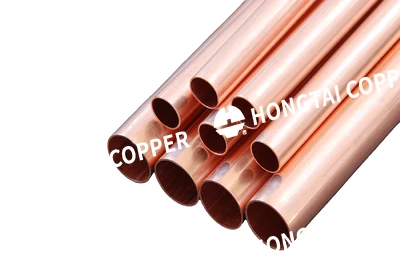

Copper tubes are widely used in heating, ventilation, air conditioning, refrigeration, plumbing, medical gas distribution and industrial equipment. Their combination of thermal conductivity, corrosion resistance, formability and reliable joining performance makes them suitable for many fluid transfer and heat exchange systems.
However, not all copper tubes are interchangeable. Material grade, outside diameter, wall thickness, temper, manufacturing process and applicable standards all influence how a tube performs in service. Understanding these differences helps engineers, contractors and purchasing teams select copper tubing that meets both technical and commercial requirements.
This guide explains the main features of copper tubes, their applications across different industries, the role of TP2/C12200 phosphorus-deoxidized copper, and the specifications buyers should review before placing an order.
A copper tube is a hollow, usually cylindrical copper product designed to transfer fluids, gases or heat, or to serve as a component in mechanical and electrical equipment.
Copper tubes are commonly manufactured in straight lengths or coils. Depending on the application, they may be supplied in annealed, half-hard or hard conditions, with different dimensional tolerances, surface finishes and internal cleanliness requirements.
In engineering practice, the terms copper tube and copper pipe are sometimes used interchangeably. However, dimensional conventions vary between standards. A tube is frequently specified by its actual outside diameter and wall thickness, while certain pipe systems use nominal size designations.
For this reason, buyers should always confirm the dimensional standard rather than relying on a nominal product name alone.

The main features of copper tubes include high thermal conductivity, good corrosion resistance, useful mechanical strength, formability and compatibility with established joining methods.
Copper is an effective heat-transfer material. The thermal conductivity of high-purity copper is approximately 390-400 W/(m·K) near room temperature, although the actual value depends on composition and material condition.
Phosphorus-deoxidized copper generally has lower thermal conductivity than high-purity electrical copper because phosphorus influences its physical properties. Nevertheless, it remains highly useful for refrigeration and heat-transfer applications.
In air-conditioning and refrigeration equipment, copper tubing transfers refrigerant between compressors, condensers, expansion devices and evaporators. Proper tube sizing and heat exchanger design help support efficient heat transfer and system operation.
Copper develops a protective surface film under many normal atmospheric and water-service conditions. This contributes to its long history of use in plumbing, heating and industrial systems.
However, corrosion resistance is not unlimited. Aggressive water chemistry, excessive flow velocity, unsuitable cleaning chemicals, deposits and certain environmental contaminants may cause localized corrosion.
Material selection should therefore consider operating temperature, fluid chemistry, flow conditions and the surrounding environment.
Copper tubes can be manufactured and processed into a variety of shapes. Annealed tubing is particularly useful where bending, coiling, flaring or forming operations are required.
Hard-drawn tubing offers greater rigidity and is often selected for straight pipe runs or applications requiring dimensional stability during installation.
The appropriate temper depends on installation methods, bending radius, mechanical loads and the applicable product standard.
Copper tubes can be joined through several established techniques, including brazing, soldering, mechanical fittings and other approved connection methods.
For refrigeration systems, brazing is commonly used to create permanent joints. Joint quality depends on surface preparation, suitable filler metal, correct heating procedures and cleanliness.
During refrigeration-system brazing, a controlled nitrogen purge is commonly used to limit internal oxidation. This helps reduce the formation of oxide scale that could contaminate sensitive system components.
Properly selected and installed copper tubing can provide long service life in suitable operating environments. Its durability depends on material quality, installation practices, operating pressure, corrosion conditions and maintenance.
Copper is also recyclable. Recovered copper can be reprocessed into new copper products, helping preserve valuable metal resources.
Copper tubes are used in systems requiring dependable heat transfer, fluid transport, corrosion resistance or controlled dimensional performance.
In HVAC systems, copper tubes are widely used as refrigerant lines connecting indoor and outdoor equipment, as well as in heat exchangers and other refrigeration circuits.
Annealed copper coils are frequently selected for installation work because they can be routed through buildings with fewer intermediate joints. Straight copper tubes are also used where rigid runs, controlled alignment or prefabricated assemblies are preferred.
When selecting tubing for an air-conditioning system, engineers should consider the refrigerant, design pressure, tube diameter, wall thickness, cleanliness, installation method and equipment manufacturer's requirements.
For projects involving air-conditioning and refrigeration, buyers can explore Hongtai's refrigeration copper tube products and review the available forms and specifications.
Copper tubing is extensively used in refrigerators, freezers, refrigerated display cabinets, cold storage systems and commercial refrigeration units.
Its formability allows manufacturers to produce compact assemblies, while its heat-transfer properties support the operation of condensers and evaporators.
Refrigeration tubing requires particular attention to internal cleanliness. Moisture, residual oil, particles and oxide scale may affect system reliability and can interfere with valves, compressors and other components.
For refrigeration procurement, internal cleanliness, sealed tube ends, pressure testing and suitable packaging may be just as important as basic dimensional specifications.
Copper pipes have been used for domestic and commercial water distribution for many years. They are valued for their durability, resistance to heat and compatibility with established plumbing fittings.
Applications include hot and cold water supply, heating circuits and selected building services installations.
Plumbing systems must be designed with attention to water quality, velocity, pressure, temperature and local regulations. Copper is not automatically suitable for every water chemistry or treatment condition.
For potable-water installations, buyers should verify that the tube, fittings and joining materials comply with applicable drinking-water requirements.
Medical gas systems use copper tubing manufactured and handled under strict requirements for cleanliness, traceability and installation quality.
Depending on the applicable standards, copper tubes may be used for oxygen, medical air, vacuum and other designated medical gas services.
Medical gas tubing is not simply ordinary plumbing copper tube. Product standards and project specifications may require particular material conditions, cleaning processes, end protection and documentation.
Engineers should specify the applicable medical gas standard and verify that the supplied product is suitable for the intended service before installation.
Copper tubes are used in industrial heat exchangers, cooling assemblies, heating equipment and other thermal management systems.
Tube geometry is important in these applications. Smooth tubes, internally grooved tubes and specially formed tubes may provide different heat-transfer and pressure-drop characteristics.
Selection should account for heat-transfer requirements, fluid compatibility, operating pressure, mechanical loads, cleaning procedures and expected service conditions.
Some copper tubes are used as conductive or structural components in electrical and industrial equipment.
These applications may require different material grades from those commonly used in refrigeration. High electrical conductivity, dimensional accuracy and mechanical properties may become primary selection criteria.
Buyers should not assume that phosphorus-deoxidized copper has the same electrical conductivity as high-conductivity electrical copper. The correct material grade must be established according to the application.
TP2 and UNS C12200 are closely corresponding phosphorus-deoxidized copper designations commonly associated with tubing for refrigeration, HVAC, plumbing and related applications.
TP2 belongs to the Chinese copper material designation system, while C12200 is a Unified Numbering System designation used in North America. Related international designations include Cu-DHP and JIS C1220.
These designations refer to comparable material families, but buyers must still verify the exact product standard, chemical requirements, temper and dimensional tolerances specified in a purchase order.
| Element | Composition | Technical Significance |
|---|---|---|
| Copper (Cu) | 99.90% minimum | Base metal providing thermal conductivity and formability |
| Phosphorus (P) | 0.015%-0.040% | Deoxidizing element associated with the material's processing and service characteristics |
The values above describe the nominal UNS C12200 material composition requirements. Actual acceptance criteria must be taken from the applicable standard and material certification.
Phosphorus-deoxidized copper is suitable for many applications involving heating, forming and brazing. Its controlled oxygen content helps reduce susceptibility to hydrogen-related embrittlement during appropriate high-temperature processing.
These characteristics make the material useful in refrigeration and plumbing applications where dependable joining and forming performance are important.
However, TP2/C12200 should not be treated as equivalent to T2 electrical copper. T2 is associated with a different copper material family and is generally selected where higher electrical conductivity may be required.
Copper tubing is available in several product forms, each suited to different manufacturing, transportation and installation requirements.
| Product Form | Typical Characteristics | Common Applications | Key Purchasing Considerations |
|---|---|---|---|
| Straight Copper Tube | Rigid or semi-rigid straight lengths | Plumbing, HVAC fabrication, equipment assemblies | Length, straightness, temper, OD and wall thickness |
| Pancake Copper Coil | Compact coiled tubing, commonly supplied in annealed condition | Air-conditioning installation and refrigeration lines | Coil length, OD, wall thickness, end sealing and packaging |
| Level Wound Coil (LWC) | Continuously wound tubing for production-line feeding | Heat exchanger and refrigeration equipment manufacturing | Coil weight, winding quality, tube cleanliness and unwinding method |
| Capillary Copper Tube | Small-diameter tubing requiring precise dimensions | Refrigeration metering and specialized equipment | Inside diameter, tolerances, cleanliness and flow characteristics |
| Inner Grooved Copper Tube | Internally structured tube surface | Heat exchangers and thermal equipment | Groove geometry, dimensional consistency and design requirements |
For installation projects requiring compact and manageable tubing, pancake copper coil products can provide a practical alternative to straight lengths, subject to the specified dimensions and temper.
For high-volume manufacturing, continuously wound coils may help reduce handling interruptions and support automated processing. The appropriate format depends on production equipment, tube specification and required coil capacity.
Selecting the right copper tube requires matching the material grade, dimensions, mechanical condition and product standard to the intended operating environment.
Start by identifying the service medium, design pressure, operating temperature, expected mechanical loads and installation environment.
For refrigeration systems, confirm the refrigerant type and equipment requirements. For water systems, review water chemistry and local plumbing standards. For medical gas installations, follow the applicable medical gas regulations and project specifications.
Outside diameter and wall thickness are essential dimensional parameters. They affect flow characteristics, pressure resistance, mechanical strength and compatibility with fittings.
For example, a tube specified as 9.52 mm outside diameter and 0.8 mm nominal wall thickness has a nominal inside diameter of approximately 7.92 mm before dimensional tolerances are considered.
This geometric relationship does not establish the tube's allowable working pressure. Pressure ratings must be determined using the relevant standard, material condition, design temperature and engineering calculations.
Annealed copper tubing is generally preferred when significant bending or forming is required. Hard-drawn tubing is more suitable where rigidity and straightness are important.
The specified temper should match both the installation process and the relevant product standard.
Different applications may reference standards such as ASTM B280 for air-conditioning and refrigeration tubing, ASTM B88 for water tubing, or other relevant national and international standards.
A material designation alone does not establish compliance with every product standard. Buyers should specify the complete standard designation and required edition when ordering.
Depending on the application, buyers may require chemical composition reports, dimensional inspection, mechanical testing, leak testing, cleanliness verification and material traceability.
For refrigeration and medical gas applications, appropriate internal cleanliness and end protection deserve particular attention.
A complete copper tube inquiry should provide sufficient technical information for the manufacturer to confirm material suitability, manufacturing capability and delivery conditions.
Recommended RFQ information includes:
Application and intended service medium
Material grade, such as TP2 or UNS C12200
Applicable product standard and edition
Outside diameter and wall thickness
Required tube length or coil dimensions
Temper or mechanical condition
Dimensional tolerances and surface requirements
Internal cleanliness and tube-end protection
Inspection, testing and certification requirements
Order quantity, packaging and delivery destination
Providing these details at the inquiry stage helps reduce specification misunderstandings and supports more accurate quotations.
Qingdao Hongtai Copper Tube Co., Ltd. manufactures copper tubing and related copper products for HVAC, refrigeration, plumbing and industrial applications.
Its product range includes straight copper tubes, refrigeration tubing, copper coils, capillary tubes, specialized copper tubes and copper fittings. Different product forms help customers match their material requirements to installation and manufacturing processes.
For buyers evaluating several copper tube types, Hongtai's copper tube product range provides a starting point for comparing available configurations and discussing project requirements.
Customers should confirm the specific grade, dimensions, temper, testing requirements and availability for each product before ordering. Special requirements should be reviewed against the applicable technical specifications.
Copper tubes are widely used in air-conditioning, refrigeration, plumbing, heating, medical gas distribution and industrial heat-transfer equipment. The correct tube specification depends on the service conditions and applicable standards.
Copper is used in refrigeration systems because of its thermal conductivity, formability, corrosion resistance under suitable conditions and compatibility with established brazing methods. Refrigeration tubing must also meet appropriate cleanliness and pressure requirements.
The terms are sometimes used interchangeably, but dimensional conventions differ by standard. Tubes are commonly specified by outside diameter and wall thickness, while some pipe systems use nominal size designations.
TP2 and C12200 are closely corresponding phosphorus-deoxidized copper grades under different designation systems. They have similar intended applications, but compliance with a specific standard must be confirmed independently.
Yes, appropriately specified copper tubing is used in drinking-water systems. Suitability depends on water chemistry, approved materials, installation practices and compliance with applicable local regulations.
Coils are often preferred for flexible installation routes and continuous manufacturing operations, while straight tubes are useful for rigid runs and controlled fabrication. The selection should consider temper, tube dimensions, installation method and handling requirements.
Copper tubes provide a versatile solution for heat transfer, fluid distribution and industrial manufacturing. Their thermal performance, formability, joining characteristics and durability make them suitable for a wide range of applications when properly specified.
For HVAC and refrigeration applications, TP2/C12200 phosphorus-deoxidized copper is an important material option. However, reliable system performance depends on more than material designation alone. Dimensions, temper, product standards, cleanliness, operating conditions and installation quality must all be considered.
Qingdao Hongtai Copper Tube Co., Ltd. offers copper tube products for different industrial and building-services applications. Buyers can contact Hongtai through its official website to discuss suitable product forms, specifications and quotation requirements.