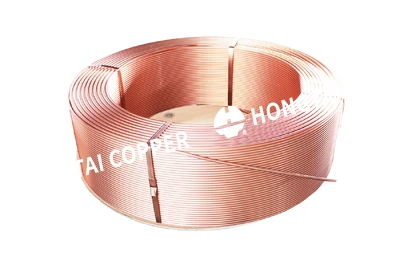

In the world of residential and commercial HVAC installation, the “split-system” is the most common configuration. Connecting the indoor evaporator to the outdoor condenser requires a conduit that is not only highly conductive but also incredibly flexible. This is where the pancake copper coil becomes the technician's most valued material.
Named for its flat, spirally wound, double-layered appearance, the pancake coil copper tube is engineered specifically for field service. Unlike rigid straight pipes, pancake coils allow for long, joint-free runs, reducing the potential for leaks. However, not all coils are created equal. For a contractor, the difference between a high-quality coil and a “budget” alternative is the difference between a 20-year leak-free system and a costly emergency callback. This article provides a deep technical dive into the standards, pressure ratings, and installation best practices for pancake copper tubes.
When a technician picks up a pancake copper coil at a wholesale shop, the first thing they should look for is the “ASTM B280” stamp. This is the international standard for copper tube used in Air Conditioning and Refrigeration (ACR) field service.
Quality pancake coils are manufactured from C12200 Phosphorus-Deoxidized High Residual Phosphorus (DHP) copper.
Copper Purity: Minimum 99.90%.
Phosphorus Content: 0.015% to 0.040%.
The phosphorus ensures that the copper does not become brittle during brazing, which is a critical safety factor when dealing with modern high-pressure refrigerants.
In the factory, copper starts as a hard, rigid material. Through a process called annealing (heating and controlled cooling), the copper is softened to a “Soft Annealed” or O60 temper. This is what gives the pancake copper tube its characteristic flexibility, allowing it to be unrolled and bent by hand without cracking.
The HVAC industry has moved from R22 to R410A, and now toward R32 and R454B. These newer refrigerants operate at significantly higher pressures. A standard 1/4" liquid line in an R410A system can see pressures exceeding 450 PSI during normal operation.
HONGTAI Copper ensures that every pancake coil copper tube maintains a strict wall thickness tolerance to ensure safety. Below is the technical data for standard ACR sizes:
| OD (Inches) | OD (mm) |
|---|---|
| 1/4" | 6.35 |
| 3/8" | 9.52 |
| 1/2" | 12.70 |
| 5/8" | 15.88 |
| 3/4" | 19.05 |
The #1 enemy of a modern inverter compressor is internal contamination. Even a microscopic amount of moisture or carbon dust can react with POE (Polyolester) oil to form acid and sludge, which eventually burns out the compressor motor.
At HONGTAI, our pancake copper coils undergo Bright Annealing in a protective atmosphere. This ensures that the interior of the tube remains free of “black oxide” scale.
Dehydration: After drawing, the tubes are dehydrated to ensure no moisture is trapped inside.
Nitrogen Purging & Capping: The ends are capped or plugged immediately after production. Technicians should never buy a coil that has missing end caps, as this indicates the internal cleanliness has been compromised.
Using a high-quality pancake copper tube is only half the battle; proper field handling is essential for system longevity.
Because the pancake coil copper tube is soft, it is susceptible to “kinking” if bent too sharply.
Rule of Thumb: Use a radius of at least 3 to 5 times the tube’s diameter.
Tooling: For tight corners, always use a spring bender or a mechanical lever bender. A kinked line creates a “pressure drop” that forces the compressor to work harder, reducing the system’s SEER rating.
A high-quality pancake copper coil from a reputable China copper tube manufacturer will have a uniform grain structure. This makes “flaring” (for flare nut connections) and “swaging” (for joining two tubes) much easier.
Pro Tip: Always use a drop of refrigeration oil on the flaring tool to ensure a smooth, burr-free flare that won’t leak over time.
For HVAC shop owners and engineering procurement managers, choosing the right supplier is a strategic decision.
Don’t just take the vendor’s word for it. Ensure the pancake copper coil has the following information laser-etched or ink-jetted onto the tube every few feet:
Manufacturer Name (e.g., HONGTAI).
Standard (ASTM B280 or EN 12735-1).
Size (OD and Wall Thickness).
In the warehouse, pancake copper tubes are often stacked. Substandard packaging leads to “flattened” tubes at the bottom of the pallet. HONGTAI uses reinforced, double-walled corrugated cartons and robust palletizing to ensure every coil arrives perfectly round and ready for installation.
As a leading China copper tube manufacturer, HONGTAI understands the reality of the job site. We know that technicians need a tube that is:
Easy to Work With: Consistent annealing for effortless bending.
Clean: Exceeding ASTM standards for internal residue.
Safe: Verified pressure ratings for the most demanding R410A systems.
Whether you are running a 50-foot line set for a residential split or a complex manifold for a VRF system, HONGTAI’s pancake copper coils provide the reliability you need to finish the job and move on to the next one without fear of leaks.
In the HVAC industry, your reputation is built on the joints you make and the materials you use. A pancake copper coil might seem like a simple commodity, but it is the most critical component for the long-term health of the refrigeration cycle. By insisting on ASTM B280 compliant tubes from HONGTAI Copper, you are investing in the efficiency and durability of every system you install.