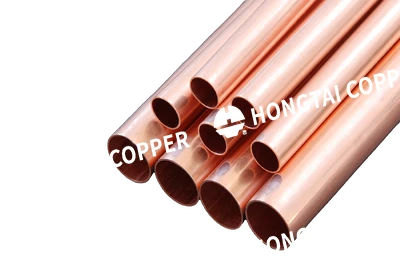

The Backbone of Modern CoolingIn the global HVAC&R (Heating, Ventilation, Air Conditioning, and Refrigeration) industry, copper remains the undisputed king of thermal conductivity. As the world shifts toward high-efficiency cooling systems and environmentally friendly refrigerants, the demand for high-purity copper tubing has surged. For global wholesalers and distributors, the challenge is no longer just finding a supplier, but identifying China copper tube manufacturers who can bridge the gap between competitive pricing and uncompromising technical standards.
As a wholesaler, your reputation depends on the reliability of the materials you provide to contractors and engineers. A single batch of sub-standard tubing can lead to catastrophic system failures, refrigerant leaks, and costly insurance claims. This article serves as a comprehensive technical guide to navigating the Chinese copper market, understanding international benchmarks, and why HONGTAI Copper stands at the forefront of this industrial evolution.
The first filter any professional buyer should use is compliance with international standards. In the HVAC world, "copper is just copper" is a dangerous myth. The chemical composition, temper, and cleanliness of the tube are strictly regulated.
For any distributor targeting the US or Canadian markets, ASTM B280 is the non-negotiable requirement for ACR (Air Conditioning and Refrigeration) field service. Unlike general plumbing pipe (ASTM B88), ASTM B280 requires:
Dehydration: The tube must be free from moisture to prevent ice formation in expansion valves.
Cleanliness: Residual carbon on the internal surface must not exceed 0.038 g/m². Excess carbon reacts with modern synthetic oils (POE/PAG), leading to compressor "sludging."
Cap-and-Seal: Every pancake copper tube must be capped or plugged to maintain this cleanliness during transit.
European markets demand compliance with EN 12735-1. This standard is particularly rigorous regarding the "Eddy Current Testing" (ECT) of the tube, ensuring that even microscopic pinholes are detected during the manufacturing process.
Given the extreme UV and coastal conditions in the Southern Hemisphere, AS/NZS 1571 focuses heavily on the grain size and tensile strength of the copper, ensuring it can withstand the high-vibration environments of outdoor condenser units.
---
The heart of a high-quality HVAC system is the alloy grade. At HONGTAI, we utilize C12200 (DHP Copper).
Copper in its "tough pitch" form contains oxygen, which can lead to "hydrogen embrittlement" when the tube is brazed or welded. By adding a controlled amount of phosphorus (0.015% to 0.040%), we remove the oxygen. This results in:
Superior Joinability: The copper flows better during brazing, creating a leak-proof seal.
Corrosion Resistance: It is significantly more resistant to "pitting" corrosion in damp environments.
Enhanced Ductility: This allows for the extreme bending required in a pancake coil copper tube without the risk of kinking or cracking.
---
Chapter 3: Focus on the "Pancake Copper Tube" – The Contractor's Choice
For the retail and installation market, the pancake copper tube is the most sought-after product. Its name comes from its flat, double-layered spiral winding.
A pancake coil must be "Soft" (O60 temper) so that an installer can unroll it and bend it by hand or with a spring bender. HONGTAI utilizes a Vacuum Bright Annealing process. Unlike traditional open-air heating, vacuum annealing prevents oxygen from touching the copper. This ensures the tube is as shiny and clean on the inside as it is on the outside, with no "black scale" that could clog a refrigerant filter.
With the industry moving away from R22 to higher-pressure refrigerants like R410A, wall thickness consistency is critical. A standard 1/4" (6.35mm) OD tube with a 0.76mm wall thickness has a burst pressure significantly higher than its operating pressure, providing a 5:1 safety factor. Distributors must ensure their manufacturer provides a "Mill Test Certificate" (MTC) for every batch to verify these pressure ratings.
---
A wholesaler's most profitable strategy is "Total Solution Sourcing." Selling a copper tube is only half the battle; the contractor also needs the elbows, tees, and reducers to connect them.
The market for copper fittings from China has matured significantly. High-quality fittings are now manufactured using Wrot Copper (Wrought) technology rather than casting. Wrot fittings are thinner, lighter, and have the exact same thermal expansion coefficient as the tube itself.
In many complex VRF (Variable Refrigerant Flow) installations, space is at a premium. The FTGxC reducer (Fitting x Cup) is a specialized component that allows a technician to change line sizes without adding extra length to the joint.
B2B Tip: Offering specialized fittings like the FTGxC reducer shows your customers that you understand their engineering challenges, positioning you as a technical partner rather than just a commodity trader.
---
When you source from China copper tube manufacturers, you must ask: Do you make your own mother tubes?
HONGTAI Copper is a vertically integrated manufacturer. This means we control the process from the melting of 99.99% pure copper cathodes to the final winding of the LWC copper coil.
Cost Control: By removing the middleman who sells mother tubes to smaller drawing mills, we provide more stable pricing in a volatile LME (London Metal Exchange) market.
Traceability: Every coil has a unique ID. If a contractor reports a leak 5 years from now, we can trace it back to the specific furnace heat and the chemical composition of that day.
---
For a wholesaler, the price on the invoice is not the final cost. Damage during sea freight is a major "hidden cost" in the copper industry.
Pancake Coil Packaging: Individual coils should be shrink-wrapped and placed in reinforced cardboard cartons. At HONGTAI, we palletize these cartons with plastic "corner protectors" to prevent the weight of the stack from crushing the bottom coils.
Moisture Protection: We utilize silica gel desiccant and nitrogen-purged ends (for LWC) to ensure that even after a 45-day sea voyage, the copper arrives in "factory-fresh" condition.
---
Sourcing HVAC copper is a balance of technical rigor and logistical efficiency. By choosing a manufacturer that understands the nuances of ASTM B280, the flexibility requirements of a pancake coil copper tube, and the precision of an FTGxC reducer, wholesalers can build a resilient and profitable business.
HONGTAI Copper is not just a factory; we are an engineering partner. Our commitment to global standards and vertical integration ensures that your customers—the contractors and engineers—have the highest quality "veins" for their cooling systems.
Looking to upgrade your HVAC inventory? Contact HONGTAI Copper today for a full technical catalog and a customized quote for bulk LWC and Pancake Coils.