
Copper fittings look simple, but they are often the silent factor behind system stability, installation speed, and maintenance cost. In air-conditioning systems, a small fitting error can create rework, leakage risk, or unnecessary pressure drop. In plumbing or general copper piping systems, choosing the wrong fitting type or the wrong supplier can slow projects and increase field complaints. That is why professional buyers search not only broad terms like “fittings” but commercial long-tail phrases such as copper tee manufacturer, copper fittings china, or even specific items like ftgxc reducer.
Hongtai supplies copper fittings together with related copper tube products for HVAC, plumbing, refrigeration, and project-based purchasing. Buyers should select each fitting according to its function, tube size, connection method, operating conditions, and required standard.
The sections below explain the principal fitting types, leakage-risk factors, joining considerations, supplier evaluation points, inventory planning, and RFQ information required for a more accurate quotation.
Copper fitting types are the shaped connectors used to join, redirect, branch, reduce, or terminate copper tube systems in HVAC, plumbing, refrigeration, and industrial piping applications.
Buyers often need more than a list of names. A fitting is selected because it changes direction, creates a branch, changes line size, joins two sections, allows disassembly, or closes the end of a line. The function should therefore be confirmed before the size and connection details are finalized.
Fitting type selection influences installation complexity and operating reliability. An incorrect reducer can create an unsuitable line transition, a tee with poor dimensional consistency can complicate fit-up, and an elbow with rough edges or inconsistent geometry can make joining more difficult.
Buyers can review Hongtai’s copper fittings china range, compare copper tube fittings types, and check the specific ftgxc reducer page when a defined reducer pattern is required.
The most common copper fittings China exporters supply include elbows, tees, reducers, couplings, caps, and unions, each serving a different flow-management or connection purpose.
An elbow changes direction. A tee creates a branch line. A reducer changes line size. A coupling joins two straight sections. A cap closes a line end. A union allows easier disassembly and maintenance. These categories are simple enough to teach quickly, but strong content should go one step further and explain where buyers most commonly use them. For example, elbows are fundamental in routing around equipment and structural limitations. Tees are critical where a branch line feeds another device or section. Reducers are essential when line diameter needs to transition while preserving a clean connection strategy.
An FTGXC reducer is a specific fitting configuration used where the connection must transition between different diameters or end types. Buyers should confirm the exact dimensional drawing, connection orientation, tube compatibility, and quantity rather than relying on the product name alone.
Commonly ordered in several branch sizesOften specified by exact size, end type, or connection code
| Fitting Type | Main Function | Typical Use | Commercial Note |
|---|---|---|---|
| Elbow | Change pipe direction | Routing in tight spaces and around equipment | Very common in HVAC and plumbing |
| Tee | Create a branch | Split flow or add a side connection | |
| Reducer | Change pipe size | Transition between different diameters | |
| Coupling | Join straight sections | Extend or repair a line | Common, often price-sensitive |
| Cap | Close a line end | Termination or temporary closure | Often ordered with other fittings |
| Union | Support detachable connection | Maintenance and service access | Important in serviceable systems |
The table provides a quick functional comparison, but final selection should also consider tube size, connection method, working pressure, installation space, serviceability, and applicable standards.
Copper fitting choice affects leakage risk because dimensional consistency, surface finish, joint design, and installation compatibility all influence how reliably the connection can be made.
Leakage is not caused by fitting choice alone, but fitting choice plays a major role in the system. If a fitting is poorly matched to the tube, if the dimensional control is inconsistent, or if the joining route is not properly considered, the probability of field problems increases. Buyers sometimes focus heavily on initial price and overlook the fact that even one leak can create service call costs, product downtime, or installation schedule disruption. This is why leak prevention is not just an engineering topic. It is a purchasing topic.
The best way to reduce leakage risk is to confirm material compatibility, tube and fitting dimensions, connection method, surface condition, and end use before installation. Reducers must match the planned line transition, and all joint surfaces should be prepared in accordance with the selected joining procedure.
Hongtai can position itself well here by combining product presentation with installation-awareness language. Buyers do not want vague promises of “high quality.” They want to know how the supplier’s quality relates to fit-up, joining, and reliability in the end system.
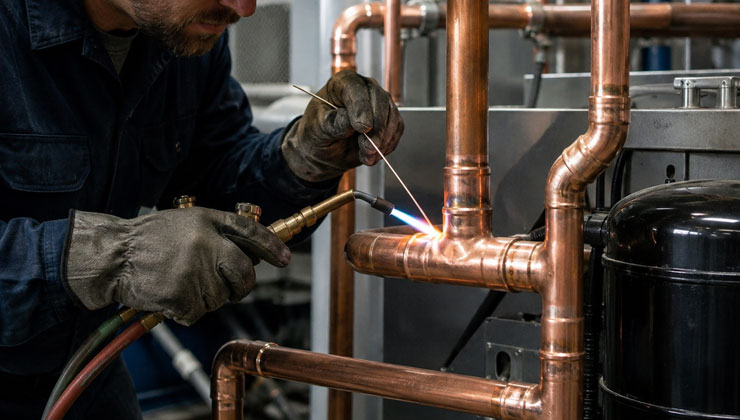
Joining logic matters because even the right fitting type will underperform if the connection process, filler material, or installation practice is not matched to the application.
Copper fittings are part of a complete joining system that may involve brazing filler, cleaning, heating control, purge requirements, and post-join inspection. The selected fitting must therefore be compatible with both the tube and the approved installation procedure.
Some projects also require related consumables or accessories. Buyers should specify the joining method and service conditions so that fittings, tubes, and filler materials can be reviewed together rather than ordered as unrelated items.
From a commercial perspective, this context reduces friction in inquiry conversations. When buyers see that the supplier understands how fittings behave in the actual jointing process, they are more likely to trust recommendations on reducers, tees, and line transitions.
Evaluating a copper tee manufacturer or copper fitting supplier means checking product consistency, category breadth, application understanding, and response quality rather than relying on price alone.
In B2B sourcing, the fastest way to waste time is to compare only ex-works prices while ignoring hidden differences in service quality, SKU clarity, and technical communication. A professional buyer should evaluate at least seven areas: product range, dimensional consistency, grade communication, package discipline, speed of quotation, application understanding, and export support. These factors directly affect whether an order proceeds smoothly.
When evaluating Hongtai or another supplier, buyers should request clear product dimensions, available size ranges, packing information, and application confirmation. A specific reducer or tee should be reviewed against the drawing or system requirement before the order is released.
| Supplier Evaluation Point | Why It Matters | What a Good Supplier Shows |
|---|---|---|
| Category coverage | Reduces sourcing fragmentation | Elbows, tees, reducers, couplings, and related items in one supply system |
| Technical communication | Speeds RFQ clarification | Clear answers on size, application, and material family |
| Commercial responsiveness | Supports project timing | Fast and structured quotation process |
| Application knowledge | Improves recommendation quality | Ability to discuss HVAC, plumbing, and industrial use |
| Documentation support | Builds trust | Willingness to provide product details and shipment information |
Numbers matter here as well. A structured RFQ for fittings usually includes at least five pieces of core information: product type, size, quantity, target application, and destination market. Adding a sixth item—connection or joining preference—often results in a more accurate quote.
Practical buying scenarios help buyers match fitting type to the job instead of browsing categories without decision confidence.
Scenario one: an HVAC installer needs elbows and reducers for a split-system connection set. In that case, route changes and line-size transitions are central. Scenario two: a distributor wants a broader copper fittings assortment, so category coverage and SKU clarity matter more. Scenario three: a manufacturer needs repeatable fittings that integrate well into a stable production workflow, making fit consistency and supplier responsiveness more important than one-time price concessions. Scenario four: a project buyer needs a narrow but specific item such as an FTGXC reducer, in which case targeted product information becomes the deciding factor.
These scenarios show why the same fitting range can serve very different purchasing needs. An installer may prioritize immediate fit and jobsite convenience, while a distributor may prioritize SKU coverage and a manufacturer may prioritize repeatability across larger batches.
Quality control points in copper fittings include dimensional consistency, edge finish, material communication, packing discipline, and the supplier’s ability to connect the part to the intended system use.
Many buyers assume fittings are easy to source because they are relatively small parts. In reality, poor dimensional consistency, damaged edges, contamination, or mixed packaging can create serious downstream issues. Inspection should therefore cover both the individual fitting and the way the order is identified and packed.
A useful checklist starts with geometry and fit. The fitting should align cleanly with the intended copper tube size. Surface finish and edge condition matter because rough finishing can complicate preparation and joining. Product identification and packaging also matter because export buyers often need to receive and sort several fitting types at once. A supplier that understands these pain points can reduce friction for the customer before the goods even leave the warehouse.
Hongtai can provide product information and quotation support based on fitting type, size, quantity, application, and destination requirements. Buyers should request clarification when a product code or connection description is not fully defined.
Inventory planning and SKU strategy matter because fittings are often purchased as part of a broader system requirement, and buyers need the right assortment mix rather than only one low-priced item.
Distributors rarely succeed by buying random fitting SKUs in isolation. They need a balanced structure that supports what their customer base actually installs or manufactures. In air-conditioning applications, for example, elbows, reducers, and tees may all move together because real systems require line routing, transitions, and branches. Project buyers face a different challenge: they need completeness and predictability. Missing one small fitting can delay an entire installation stage.
Distributors can plan stock by grouping fittings that are commonly used together, while project buyers should prepare a completeness checklist for each installation stage. This reduces the chance that one missing reducer, tee, or coupling delays the whole system.
Assortment planning can also reduce emergency freight and fragmented purchasing. A complete order may have a higher initial value, but it can lower administrative effort and prevent schedule disruption caused by missing small components.
Copper fittings and tubes should be ordered as one compatible system whenever possible, with the fitting dimensions, tube dimensions, material family, joining method, and end use reviewed together.
A buyer requesting reducers, elbows, or tees may also require matching tubes. Ordering the components together can simplify compatibility review, packing coordination, and shipment planning, especially when several sizes are involved.
For a combined order, the RFQ should include a fitting schedule and a tube schedule. Drawings or connection diagrams are useful when the product code does not fully define the required geometry.
Hongtai can review the tube and fitting requirements together and identify points that require dimensional confirmation before production or shipment.
The cheapest fitting is not always the lowest-cost choice because installation delays, mismatch risk, and field rework can erase any apparent unit-price advantage.
In B2B sourcing, real cost includes more than the purchase price. If a fitting creates assembly problems, requires replacement, or delays installation, the project cost rises quickly. Buyers should compare fit consistency, packaging, supplier communication, and compatibility along with the quoted unit price.
Total-cost evaluation should include expected rework, replacement freight, site labor, production interruption, and the time required to resolve mismatched components. These costs can be much higher than a small difference in fitting price.
Good documentation and RFQ preparation make copper fitting orders faster, clearer, and less likely to require repeated clarification.
This also helps sales teams compare requests internally and recommend the most suitable copper fitting route with fewer delays.
At a minimum, the buyer should identify the fitting type, size, quantity, target application, and destination market. For more technical projects, it is also helpful to mention whether the fittings will be used in HVAC, plumbing, or another copper piping system, and whether any special packing or shipment requirements apply. This level of preparation does not make the inquiry longer in a negative sense; it makes it more actionable.
Hongtai can prepare a more accurate offer when the RFQ identifies the fitting type, size, quantity, application, destination market, and any special packing or joining requirements.
Dimensional review should confirm the nominal size, connection ends, insertion depth, geometry, and orientation before the fitting is released for production or installation.
Fitting names alone are not always enough. A reducer may be concentric or follow a defined end configuration; a tee may have different branch and run sizes; an elbow may require a specific angle or radius; and a coupling may be designed for a particular connection method. Drawings, samples, or clear dimension tables are especially helpful when several similar fitting codes exist.
For repeat orders, buyers should keep an approved specification or reference drawing rather than relying on a previous verbal description. This reduces the risk that a product with a similar name but different geometry is supplied.
Packaging and identification are especially important for mixed fitting orders because several small SKUs can look similar and become difficult to sort after arrival.
Each carton or inner package should identify the fitting type, size, quantity, and order reference. When an order contains many reducers, tees, elbows, and couplings, clear labeling reduces warehouse handling time and helps prevent installation errors. Protective packing should also prevent dents, deformation, contamination, and surface damage during international transport.
Project buyers may request packing by installation area, system section, or drawing number. Distributors may prefer SKU-based cartons that support inventory receiving and resale. These requirements should be stated before the quotation is finalized because they can affect packing labor and shipment preparation.
Receiving inspection should verify quantity, fitting type, dimensions, surface condition, packaging, and identification before the parts are issued to the jobsite or production line.
A practical receiving check begins with the packing list and carton labels. Sample pieces can then be measured against the approved drawing or dimensional table. The inspector should look for distorted openings, damaged threads where applicable, rough or damaged edges, contamination, mixed sizes, and signs of impact during transport.
If the order will be used in a controlled joining process, the buyer may also check fit-up with the matching tube before full release. This is particularly useful for large batches or project-critical fittings, where discovering a mismatch after installation has started would be costly.
Service conditions and maintenance access influence whether a permanent brazed fitting, a detachable union, or another connection arrangement is the better choice.
In concealed or difficult-to-access systems, joint reliability and installation quality are especially important because later repairs can be disruptive. In serviceable mechanical rooms, detachable connections may be useful at equipment interfaces that require inspection or replacement. The design should also consider vibration, temperature changes, corrosion environment, and physical support of the tube and fitting assembly.
Fitting selection should therefore be coordinated with the system designer and installer. A part that is dimensionally correct may still be unsuitable if it limits maintenance access or does not match the approved connection procedure.
Spare quantities should be planned according to installation complexity, project location, replacement lead time, and the criticality of each fitting type.
Large projects often include a small allowance for common elbows, couplings, reducers, and tees to cover field changes or accidental damage. The allowance should be controlled rather than arbitrary, and project-critical or difficult-to-source fittings deserve special attention. Distributors may also retain safety stock for high-turnover sizes so that urgent customer needs do not require separate express shipments.
The fitting schedule should distinguish installation quantity, planned spare quantity, and any maintenance stock required after commissioning.
1. What are the most common copper fitting types?
The most common types are elbows, tees, reducers, couplings, caps, and unions, each used for a different routing or connection function.
2. Why are copper fittings important in air conditioning systems?
They help connect, redirect, and size-match copper tube lines. Correct fitting selection improves installation quality and reduces leakage risk.
3. What does a reducer do?
A reducer transitions the connection from one tube size to another and is often necessary in system layouts with changing line diameters.
4. How can I reduce leakage risk when buying copper fittings?
Choose the correct fitting type, confirm size compatibility, and work with a supplier that communicates clearly about product application and connection context.
5. How do I evaluate a copper tee manufacturer?
Check product consistency, category range, quotation speed, and whether the supplier can explain where the product fits in a real HVAC or plumbing system.
6. What information should I send when asking Hongtai for fittings?
Send the fitting type, size, quantity, target application, destination market, and any joining or connection preferences.
Copper fittings may be smaller than copper tubes, but they have a major influence on assembly quality and long-term reliability. Buyers should select each fitting by function, dimensions, connection method, service conditions, and supplier consistency. Hongtai can help review elbows, tees, reducers, couplings, and matching tube requirements before quotation.
If you are sourcing elbows, tees, reducers, couplings, or other copper fittings, Hongtai can help you identify the right part and route you to the most relevant product page. Send your size list and quantity requirement to request a quicker quotation and recommendation.