
In HVAC, refrigeration, medical gas, and building water piping systems, the copper tee is one of the most mechanically demanding components in the entire piping network — and one of the most frequently under-specified. Unlike a straight coupler or elbow that manages flow in a single direction, a copper pipe tee must simultaneously manage flow division across three ports, maintain structural integrity at the T-intersection where stress concentration is highest, and provide reliable brazing surfaces at multiple socket interfaces — all within a compact fitting body that must perform without leakage through years of pressure cycling, thermal expansion, and vibration in demanding commercial and industrial service environments.
For buyers evaluating a reliable copper tee manufacturer for HVAC, refrigeration, medical gas, or water system applications, the quality parameters that determine long-term leakage prevention are not visible in a catalog photograph — they are the invisible manufacturing details that separate a precision-formed copper pipe tee from a visually similar but structurally inferior product: wall thickness uniformity at the branch intersection, socket depth consistency, inner surface smoothness, dimensional accuracy of all three ports, and the brazing compatibility that allows installation teams to form reliable, leak-free joints. Hongtai offers tee copper fittings used as copper pipe connectors for air conditioning, refrigeration, HVAC, building water copper pipe, and medical gas copper pipe applications, with standards including BS864 and ANSI B16.22 — providing the quality specification and application coverage that commercial and industrial copper tee procurement requires.
This guide covers the complete picture for HVAC contractors, refrigeration equipment manufacturers, building services engineers, and procurement managers: why branch connections are high-risk leakage zones, what a copper tee is and where it fits in piping systems, how wall thickness uniformity and cold extrusion forming technology reduce stress concentration and leakage risk, how to evaluate copper tee quality before bulk procurement, and what installation and maintenance practices protect piping system integrity through the fitting's service life.
The commercial case for investing in high-quality copper tee fittings starts with a clear understanding of why branch connections are statistically the most common leakage initiation points in refrigeration and HVAC piping networks — and why the specific geometry of a T-junction creates mechanical challenges that straight pipe sections and simple elbows do not face.
Stress concentration at the T-intersection is the fundamental mechanical challenge that makes copper pipe tee quality more critical than the quality of straight pipe sections or simple elbows. When internal pressure acts on a piping system, the stress in the pipe wall is distributed relatively uniformly in straight sections — but at a T-junction, the intersection of the branch port with the main run creates a geometric discontinuity that concentrates stress at the junction edges. This stress concentration means that the T-intersection experiences higher local stress than the surrounding pipe wall for the same internal pressure — and if the wall thickness at the intersection is reduced by poor forming, the local stress may approach or exceed the material's yield strength under the pressure cycling of normal refrigeration system operation.
Uneven wall thickness from inadequate forming processes compounds the stress concentration problem by reducing the wall thickness at the locations where stress is already highest. In a poorly formed copper tee, the material flow during forming may thin the wall at the branch intersection — the highest-stress location — while leaving adequate thickness elsewhere. This combination of high stress and reduced wall thickness creates the conditions for fatigue crack initiation and progressive leakage that may not appear immediately after installation but develops over months or years of pressure cycling.
Brazing defects at multiple socket interfaces create the third category of leakage risk that is specific to copper tee fittings. A copper tee has three socket interfaces — two on the main run and one on the branch — each of which must be brazed correctly to form a leak-free joint. Poor socket depth consistency, inadequate socket cleanliness, incorrect brazing temperature, or poor fit between the copper tube and the fitting socket can create incomplete brazing penetration that leaves voids or porosity in the joint — potential leakage paths that may not be detected during initial pressure testing but develop into active leaks as the joint is subjected to thermal cycling and vibration.
For contractors, HVAC distributors, refrigeration equipment manufacturers, and project buyers, a leaking copper tee fitting creates consequences that extend far beyond the cost of the fitting itself. Refrigerant leakage from a failed tee in a commercial refrigeration system creates environmental compliance risk, compressor damage from low refrigerant charge, food safety risk in cold storage applications, and expensive service intervention that may require system evacuation, leak repair, and refrigerant recharge. In medical gas systems, a leaking tee fitting creates patient safety risk and regulatory compliance consequences that are orders of magnitude more serious than the cost of the fitting.
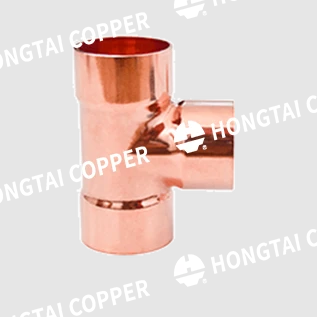
Understanding what a copper tee is — and how its design and manufacturing quality determine its performance as a pressure-bearing branch connector in demanding refrigeration and HVAC applications — is essential for procurement teams evaluating copper tee specifications for commercial and industrial projects.
A copper tee is a T-shaped copper pipe fitting used to connect three copper tubes and create a branch line in a piping system — allowing refrigerant, water, gas, or other compatible media to flow from one main line into a branch line. Hongtai describes its tee copper fitting as a copper pipe connector used for air conditioning and refrigeration pipe fittings, as well as air conditioning copper pipe fittings — with standards including BS864 and ANSI B16.22 for durable, leak-proof connections in residential, commercial, and industrial applications.
A copper tee is not a simple accessory — it is a pressure-bearing branch connector that must maintain dimensional accuracy, wall thickness consistency, and brazing reliability through years of pressure cycling, thermal expansion, and vibration in demanding service environments. Buyers who treat copper tee fittings as commodity items and select on price alone are accepting the leakage risk that inadequate manufacturing quality creates.
| Copper Tee Type | Function | Best Application |
|---|---|---|
| Equal copper tee | Three ports with the same diameter | Standard branch connection in uniform pipe systems |
| Reducing copper tee | Branch or one port has a smaller diameter | Size transition and branch distribution |
| Y-shape tee | Angled flow division for lower resistance | Applications where flow resistance reduction is important |
| Socket copper tee | Copper tube inserted into fitting socket | Brazed HVAC and refrigeration systems |
| Heavy-duty copper tee | Stronger wall and pressure-resistant design | High-pressure refrigeration and demanding HVAC systems |
The technical mechanism by which precision cold extrusion forming technology maintains wall thickness uniformity at the T-intersection and socket areas of a copper pipe tee — and why this manufacturing quality parameter is the most important determinant of leakage resistance in high-pressure refrigeration applications — is the core engineering knowledge that procurement teams need to evaluate copper tee specifications for demanding service conditions.
Cold extrusion forming is the manufacturing process that most effectively maintains wall thickness uniformity in copper tee production — because it shapes the three-port tee body through controlled material flow under high forming pressure, rather than through cutting, machining, or rough forming processes that remove material and create surface stress. In a well-controlled cold extrusion process, the copper material flows into the branch port geometry while maintaining consistent wall thickness distribution around the T-intersection — preserving the structural integrity of the highest-stress zone in the fitting.
The practical consequence of cold extrusion forming for leakage prevention is that the T-intersection — the location where stress concentration is highest and where inadequate wall thickness creates the greatest leakage risk — retains adequate wall thickness to resist the pressure cycling and thermal stress of high-pressure refrigeration service. A copper tee formed by a less controlled process may have adequate wall thickness in the straight sections of the main run but thinned walls at the branch intersection — creating the combination of high stress and reduced wall thickness that initiates fatigue cracking and progressive leakage.
For systems using modern refrigerants such as R32 — which operates at higher working pressures than older refrigerants — the wall thickness uniformity of the copper tee at the branch intersection is the quality parameter that most directly determines whether the fitting can withstand the pressure cycling of normal system operation without developing leakage over time. A heavy-duty copper tee for high-pressure refrigeration must provide reliable wall thickness at the T-intersection, accurate socket dimensions for consistent brazing penetration, and smooth internal transitions that minimize flow turbulence and pressure loss at the branch point.
| Quality Factor | Manufacturing Mechanism | Performance Impact |
|---|---|---|
| Uniform wall thickness at T-intersection | Cold extrusion forming with controlled material flow | Reduces stress concentration and fatigue crack risk |
| Consistent socket depth | Precision machining of socket dimensions | Supports reliable brazing penetration and joint strength |
| Smooth internal transition | Controlled forming and surface finishing | Reduces turbulence and flow restriction at branch point |
| Accurate port roundness | Dimensional control throughout forming process | Improves fit with matching copper tube for reliable brazing |
| Clean inner surface | Acid-free cleaning process | Prevents contamination of refrigerant circuit |
| Strong branch intersection geometry | Optimized forming die design | Resists pressure cycling and vibration in service |
The socket dimensions of a copper tee — the diameter, depth, and surface condition of the recesses into which the copper tubes are inserted before brazing — are the second most important quality parameter for leakage prevention after wall thickness uniformity. A socket with accurate diameter provides the correct clearance between the tube and fitting for capillary brazing filler flow — too tight and the filler cannot penetrate the joint, too loose and the filler cannot fill the gap completely. A socket with consistent depth ensures that the tube is inserted to the correct position for full brazing coverage. And a socket with a clean, smooth surface provides the brazing filler with a clean metal surface for reliable bonding.
The selection of the right copper tee specification for a specific application requires systematic evaluation of the service conditions, pressure requirements, refrigerant type, installation method, and quality documentation — and an understanding of how copper tee fittings compare with alternative branch connection methods for different combinations of these requirements.
| Connection Method | Advantage | Limitation | Best Application |
|---|---|---|---|
| Copper tee | Compact, strong, mature brazing connection | Requires correct brazing and size matching | HVAC, refrigeration, medical gas, water systems |
| Y-branch fitting | Smoother directional flow, lower resistance | Not always suitable for standard T-layouts | Low-resistance flow applications |
| Mechanical branch connector | Faster installation in some systems | May not match refrigeration pressure requirements | Lower-pressure applications |
| Field-fabricated branch | Flexible on-site | Higher risk of inconsistent workmanship | Emergency or custom applications |
| Manifold block | Good for multiple branches | Larger size and higher cost | Multi-branch distribution systems |
| Application | Primary Requirement | Recommended Copper Tee Direction |
|---|---|---|
| R32 high-pressure refrigeration | Wall thickness uniformity and pressure resistance | Heavy-duty copper tee with cold extrusion forming |
| VRF and VRV HVAC systems | Dimensional accuracy and brazing reliability | Standard or heavy-duty socket copper tee |
| Medical gas and oxygen systems | Internal cleanliness and pressure reliability | Clean-service copper tee with documentation |
| Building water supply | Corrosion resistance and long service life | Standard copper tee to BS864 or ANSI B16.22 |
| Cold storage refrigeration | Pressure cycling resistance and leak prevention | Heavy-duty copper tee with wall thickness verification |
| OEM refrigeration equipment | Dimensional consistency for production assembly | Precision copper tee with batch traceability |
High-quality copper tee fittings deliver the most commercial value for: commercial refrigeration systems where refrigerant leakage creates food safety risk and regulatory compliance consequences, high-pressure refrigeration systems using R32 or other modern refrigerants where higher working pressures increase the stress on branch connections, VRF and VRV HVAC systems where multiple branch levels create many tee connections that must all perform reliably, medical gas systems where leakage creates patient safety risk and regulatory consequences, and OEM refrigeration equipment manufacturers where consistent fitting quality is essential for production reliability and warranty cost management.
Procuring the right copper tee for a commercial or industrial piping application requires systematic pre-order confirmation of technical requirements, quality documentation, and supplier capability — and proper installation and maintenance practices that protect joint integrity through the fitting's service life.
Before requesting a quotation from a copper tee manufacturer, prepare and confirm the following:
Confirm the application — HVAC, refrigeration, medical gas, water supply, or other — and the specific service conditions including refrigerant type, working pressure, temperature range, and vibration environment
Confirm the tee type — equal tee, reducing tee, Y tee, or heavy-duty tee — based on the pipe sizes and flow requirements of the specific branch connection
Confirm the port sizes for all three connections — main run inlet, main run outlet, and branch outlet — and verify that the selected tee matches the copper tube sizes used in the system
Confirm the applicable standard — BS864, ANSI B16.22, GB/T, ASTM, EN, or project-specific standard — and verify that the supplier can provide compliance documentation
Confirm the wall thickness requirement — for high-pressure refrigeration applications, specify the minimum wall thickness at the branch intersection and verify that the supplier's manufacturing process can consistently meet this requirement
Confirm the copper material grade and purity requirement — high-purity copper provides better thermal conductivity, corrosion resistance, and brazing compatibility than lower-grade copper
Confirm the inner surface cleanliness requirement — for medical gas and oxygen applications, specify the cleanliness standard and verify that the supplier's cleaning process meets the requirement
Confirm the pressure testing or leakage testing requirement — and verify that the supplier can provide test documentation for each batch
Confirm the packaging requirement — fittings must be packaged to prevent deformation, contamination, and damage during transport and storage
Confirm the quantity by size and delivery schedule — verify that the supplier's production capacity can meet the project timeline
Confirm copper tube and tee sizes match exactly before installation — a poor fit between tube and socket creates inadequate brazing clearance and increases leakage risk
Clean tube ends and fitting sockets thoroughly before brazing — flux residues, oxidation, oil, and contamination on the brazing surfaces prevent complete filler penetration and create void-containing joints
Avoid overheating the tee during brazing — excessive heat can anneal the copper fitting, reduce its strength, and cause oxidation that contaminates the refrigerant circuit
Use the correct brazing filler and technique for the application — the brazing filler alloy, flux, and heating method must be appropriate for the refrigerant type, pressure rating, and service temperature
Maintain correct insertion depth — the copper tube must be inserted to the full socket depth to ensure complete brazing coverage of the joint interface
Support nearby pipe runs to reduce vibration stress on the tee connections — inadequate pipe support allows vibration to create fatigue stress at the brazed joints over time
Pressure test the complete system after installation — a system pressure test verifies that all tee connections are leak-free before refrigerant or other media is introduced
Inspect joints for signs of leakage, oxidation, or cracking at regular service intervals — early detection of developing problems allows repair before significant system damage occurs
In high-pressure refrigeration, HVAC, medical gas, and water piping systems, the copper tee is the component where manufacturing quality has the most direct impact on system reliability and leakage prevention — because the T-intersection geometry creates stress concentration that amplifies the consequences of inadequate wall thickness, poor socket accuracy, or incomplete brazing. The buyers who achieve the best long-term system reliability from their copper tee procurement are those who evaluate the invisible manufacturing details — wall thickness uniformity at the branch intersection, socket depth consistency, inner surface cleanliness, and cold extrusion forming quality — rather than selecting on catalog appearance and unit price alone.
Hongtai supplies tee copper fittings, elbows, straight couplers, reducers, P-traps, U-bends, tube caps, copper tubes, copper coils, copper welding rods, and related copper products for air conditioning, refrigeration, HVAC, medical gas, water supply, and industrial piping applications — with standards compliance including BS864 and ANSI B16.22, and a complete copper fitting range that supports one-stop procurement for commercial and industrial piping projects.
Contact Hongtai today to discuss your copper tee size, standard, wall thickness requirement, application, pressure requirement, quantity, packaging, and delivery schedule. Hongtai can help evaluate the right copper pipe tee specification for your refrigeration, HVAC, medical gas, or water system project — and provide the quality documentation and supply reliability that demanding commercial and industrial piping procurement requires.
Q1: What is a copper tee and what is it used for in piping systems?
A copper tee is a T-shaped copper pipe fitting used to connect three copper tubes and create a branch line in a piping system. It is commonly used in HVAC, refrigeration, building water supply, medical gas, and industrial piping systems to divide flow from a main line into a branch line. The copper tee is one of the most mechanically demanding fittings in a piping system because it must manage flow division across three ports while maintaining structural integrity at the T-intersection where stress concentration is highest.
Q2: Why does wall thickness uniformity matter so much in a copper pipe tee?
Wall thickness uniformity at the T-intersection is the most important quality parameter in a copper pipe tee because the intersection geometry creates stress concentration that amplifies the consequences of reduced wall thickness. A tee with uneven wall thickness at the branch intersection has a combination of high stress and reduced material strength at the same location — creating the conditions for fatigue crack initiation and progressive leakage under the pressure cycling of normal refrigeration or HVAC system operation.
Q3: What is a heavy-duty copper tee for high-pressure refrigeration and when is it needed?
A heavy-duty copper tee for high-pressure refrigeration is a stronger tee fitting designed with reliable wall thickness at the branch intersection, accurate socket dimensions for consistent brazing penetration, and strong branch geometry for demanding refrigeration systems using modern refrigerants such as R32 that operate at higher working pressures than older refrigerants. It is needed when the system working pressure, pressure cycling frequency, or vibration environment exceeds the performance capability of standard copper tee fittings.
Q4: How does cold extrusion forming improve copper tee quality?
Cold extrusion forming shapes the three-port tee body through controlled material flow under high forming pressure — maintaining consistent wall thickness distribution around the T-intersection rather than removing material or creating surface stress. This manufacturing process preserves the structural integrity of the highest-stress zone in the fitting, reducing the risk of wall thinning at the branch intersection that creates leakage risk in high-pressure service.
Q5: What standards should buyers check for copper tee fittings?
Buyers should check the applicable standards for their project and jurisdiction. Common standards for copper tee fittings include BS864 for copper fittings for use with copper tubes in plumbing and heating systems, ANSI B16.22 for wrought copper and copper alloy solder-joint pressure fittings, and GB/T standards for Chinese market applications. Hongtai lists BS864 and ANSI B16.22 as applicable standards for its tee copper fittings.
Q6: What are the most important installation practices for preventing leakage at copper tee connections?
The most important installation practices are: confirming that tube and socket sizes match exactly for correct brazing clearance, cleaning tube ends and socket surfaces thoroughly before brazing, avoiding overheating that can weaken the fitting and cause oxidation, using the correct brazing filler and technique for the application, maintaining correct insertion depth for complete brazing coverage, and pressure testing the complete system after installation to verify leak-free performance before introducing refrigerant or other media.
<p style="margin: 0px 1em 1rem; padding: 0px